
Crisp County Court Records After Arrest
After a Crisp County jail arrest, the first record usually starts inside the jail. The sheriff's booking process creates intake data, records the booking photo and fingerprints, checks warrants, and sets up bond and a court date when a judicial official acts. Court records after arrest begin when the case is filed or handled by the right court. That distinction matters because a booking charge can be changed before or after the prosecutor reviews the case.
For custody and booking detail, use Crisp County jail inmate records. For booking photos, use the Crisp County jail mugshots page. Court records after a jail arrest focus on filed charges, charge status, hearings, bond orders, warrants, accusations, indictments, dismissals, and final dispositions. The record custodian may be the Clerk, Magistrate Court, Probate Court, Municipal Court, or another court depending on the charge and case stage.
Crisp County Court Record Offices
The official county justice pages identify the key local offices in Cordele. The Clerk of Superior and Juvenile Courts is central for filed Superior Court criminal cases. Magistrate Court is important for warrants, first appearances, and early bond questions. The District Attorney prosecutes state criminal cases, but the DA's office is not a substitute for the Clerk's record function.
Clerk of Superior & Juvenile Courts
510 7th Street North
Cordele, GA 31015
229-271-4726
8:30 AM-5:00 PM
Magistrate Court
510 7th Street North, Suite 105
Cordele, GA 31015
229-271-4728
8:30 AM-5:00 PM
District Attorney Brad Rigby
510 South 7th Street, Suite 102
Cordele, GA 31015
229-271-4735
8:30 AM-5:00 PM
Find Court Records After Arrest
The county clerk page links to the Georgia Superior Court Clerks' Cooperative Authority, but the research did not locate a free Crisp County criminal docket portal with searchable defendant-name fields on the county page. The practical local path is to start with the jail record, identify the court level, and contact the correct court office for filed records. For older or certified copies, use the Clerk or court directly.
Traffic and some misdemeanor matters may also involve Probate Court or a municipal court path, depending on the charge and issuing agency. The county Probate Court page says traffic and certain misdemeanor violations fall within its jurisdiction and tells traffic defendants to wait before calling or attempting online payment. For felony charges, Superior Court and the District Attorney's office are the usual filed-charge path.
- Start with the jail record to get the booking date, arrest charge, arresting agency, warrant number, or case identifier.
- Contact the Clerk of Superior & Juvenile Courts Criminal Division at 229-271-4726 for filed Superior Court criminal cases.
- Contact Magistrate Court at 229-271-4728 for warrant, first-appearance, and early bond questions.
- Use the District Attorney's office for prosecution contact, not as a substitute for the clerk's case-record function.
Charges Filed After Arrest
Court records after a Crisp County arrest may begin with different charging documents. The exact document depends on the offense, court, and prosecutor action. A complaint may support the early case or warrant path. An accusation or information is a prosecutor-filed charge document used in many Georgia criminal matters. An indictment is returned by a grand jury, most often for felony prosecution.
| Document | Filed By | Common Use | Record Meaning |
|---|---|---|---|
| Complaint | Officer or prosecutor | Early criminal process or misdemeanor path | Starts or supports the charge record. |
| Accusation / information | Prosecutor | Many state charges depending on court and offense | Shows the charge the prosecutor chose to file. |
| Indictment | Grand jury | Serious felony prosecution | Shows a grand-jury charging decision. |
Crisp County Charge Status
Charges can change after a jail arrest. A booking charge may be a starting point, while the prosecutor can add, amend, reduce, dismiss, or decline charges later. That is why court records after arrest should be checked through the Clerk or court, not treated as identical to the jail intake entry.
| Status | What It Means |
|---|---|
| Pending | The charge or case has been filed and has not reached final disposition. |
| Amended | The filed charge was changed during prosecution or court handling. |
| Reduced | The charge was lowered to a lesser offense. |
| Dismissed | The charge ended without a conviction on that count. |
| Nolle prosequi | The prosecutor declined to proceed on the charge. |
Bond Records After Arrest
The sheriff's jail information says bail can be determined by a judicial official during the intake path, and most inmates have access to phones to arrange assistance through family, friends, or bail agents. The research did not find a Crisp County bond fee schedule or accepted payment list on the sheriff pages. Call the jail for custody and release status, and contact Magistrate Court when the issue involves first appearance, warrant status, or early bond process.
| Bond Type | How It Works |
|---|---|
| Cash bond | Money is paid to secure appearance. Local payment details were not published in the located sheriff pages. |
| Surety bond | A bail agent posts bond for a fee. The sheriff page says inmates may contact bail agents. |
| Personal recognizance | Release is based on a promise to appear, if a court allows it. |
| No-bond hold | A court order, warrant, federal hold, DOC hold, or other agency hold may block release. |
Warrants and Jail Arrest Records
No official Crisp County Sheriff's Office active warrant search page was located in the official navigation. The sheriff's booking page confirms that warrant checks are part of intake. If a warrant leads to a jail arrest, the person is transported to the jail, screened, searched, photographed, fingerprinted, and entered into the jail information system. For custody, call the jail. For warrant and early court-process questions, Magistrate Court is the strongest official contact located in the research.
Charges vs Convictions
An arrest charge is not a conviction. It is an allegation or custody basis at the start of the process. A conviction comes only after a plea, verdict, or other final adjudication. Public court records after a jail arrest may show both pending charges and final outcomes, so the status field and docket history should be read before drawing conclusions.
| Charge | Conviction | |
|---|---|---|
| Stage | Accusation or filed count | Final plea, verdict, or adjudication |
| Meaning | Not proof of guilt | Legal finding or admitted guilt |
| Can change | May be amended, reduced, or dismissed | May later be appealed or restricted only through proper legal process |
Restricted Court Records After Arrest
Georgia uses record restriction rather than the casual term expungement in many contexts. Georgia public-record access is governed by the Open Records Act, O.C.G.A. 50-18-70 et seq. Costs, timing, and production procedures are addressed in O.C.G.A. 50-18-71, while exemptions appear in O.C.G.A. 50-18-72. Juvenile matters, pending investigations, sealed or restricted records, medical information, and certain law-enforcement materials may be withheld or redacted. Georgia record restriction is handled under O.C.G.A. 35-3-37 when a criminal-history record is eligible.
| Restricted | Public | |
|---|---|---|
| Visibility | Limited from ordinary public access when legally eligible. | Available through the court or agency unless an exemption applies. |
| Who decides | Handled through Georgia legal and agency procedures. | Maintained by the court, sheriff, or agency that created the record. |
| Common issue | Dismissed, nolle prossed, or otherwise eligible criminal-history records. | Pending and final court records that have not been restricted. |
Crisp County Court Source
The Clerk of Superior and Juvenile Courts page is the local source for criminal-division contact and court-service context after a jail arrest.
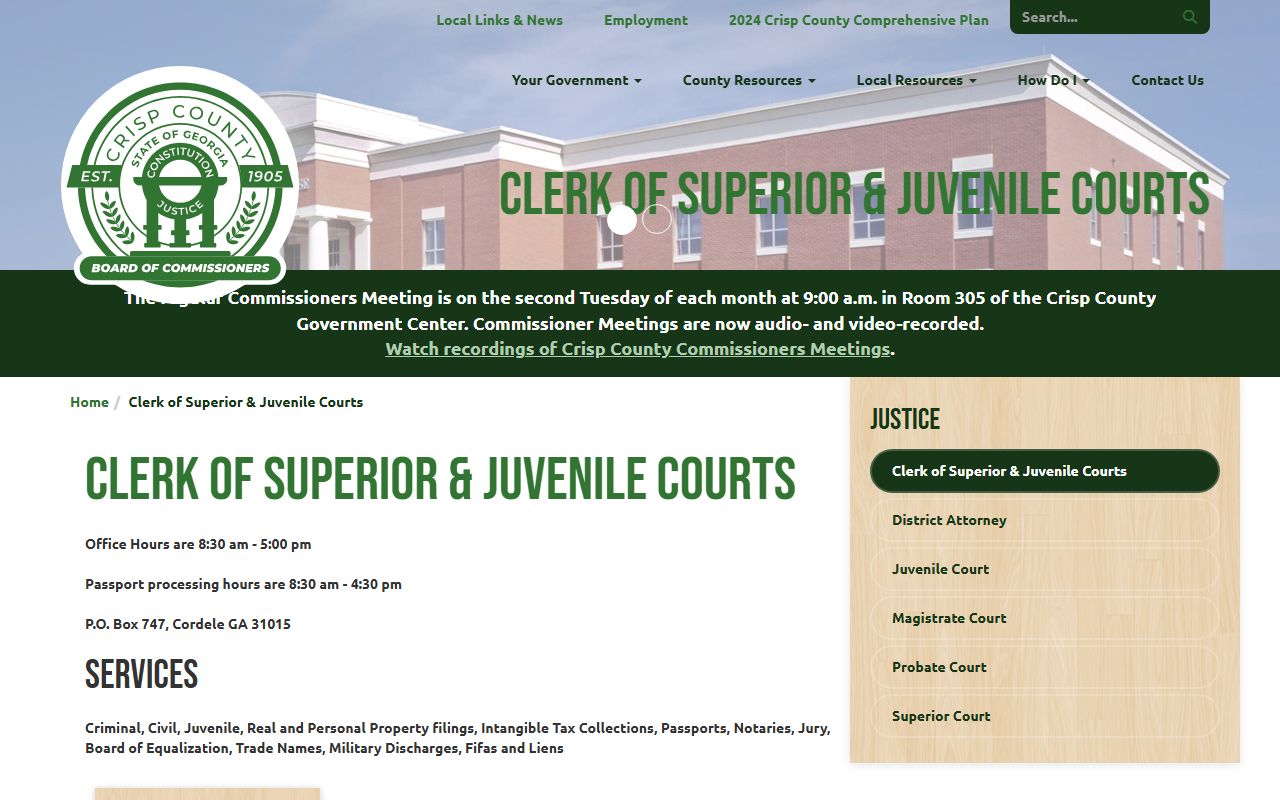
The clerk source belongs with filed charges because it is separate from the jail booking and custody function.
Important: Do not use court or jail data from this site for employment, housing, credit, insurance, or other FCRA-regulated screening.